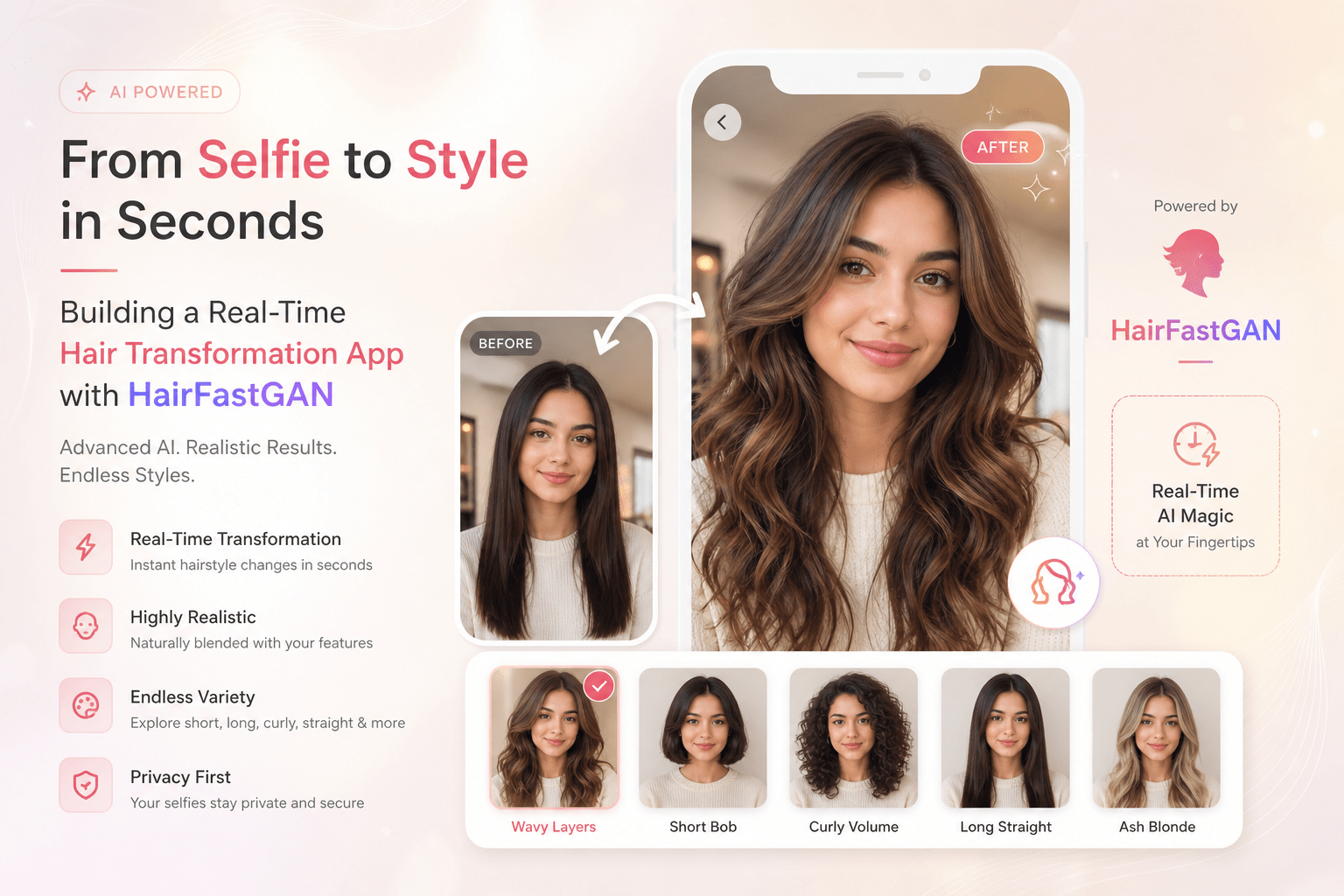
Try New Hairstyles Instantly with AI: The Complete Guide to HairFastGAN
Changing your hairstyle is exciting, but it can also feel risky. A haircut that looks great on someone else may not suit your face shape, hair texture, or personal style. Once your hair is cut or colored, there’s no instant way to undo the change.
Artificial intelligence is changing that experience.
Today, AI-powered hairstyle tools allow you to preview different hairstyles before making any real commitment. Instead of imagining how bangs, curls, or a new hair color might look, you can upload a photo and see realistic results within seconds.
One of the most interesting open-source projects in this space is HairFastGAN. Built using modern generative AI techniques, HairFastGAN can transfer hairstyle shape, texture, and color from one image to another while preserving facial identity. The result is a realistic hairstyle preview that can help users experiment confidently.
Whether you’re a developer exploring computer vision, a researcher interested in generative AI, or someone simply curious about trying a new hairstyle, HairFastGAN demonstrates how far AI-powered image editing has advanced.
In this guide, you’ll learn what HairFastGAN is, how it works, how to install it, its hardware requirements, practical applications, limitations, and best practices for getting the most realistic results.
Why AI Hairstyle Try-On Tools Are Becoming Popular
The beauty and fashion industries are rapidly adopting artificial intelligence to improve customer experiences. Instead of relying on imagination or edited sample photos, people can now visualize changes on their own faces before making a decision.
This technology offers several advantages:
- Preview hairstyles before visiting a salon.
- Experiment with different hair colors safely.
- Compare short, medium, and long hairstyles.
- Save time during consultations.
- Share hairstyle previews with friends or stylists.
- Reduce uncertainty before making a major change.
These benefits make AI hairstyle tools useful not only for individuals but also for salons, beauty brands, and developers building virtual makeover applications.
What Is HairFastGAN?
HairFastGAN is an open-source AI model designed for realistic hairstyle transfer. Instead of simply pasting one hairstyle onto another image, it analyzes facial structure, hair shape, color, and texture to generate a natural-looking result.
Unlike many earlier hairstyle editors, HairFastGAN focuses on preserving the person’s identity. Facial features such as the eyes, nose, skin tone, and expressions remain consistent while the hairstyle changes.
The project is based on modern generative adversarial network (GAN) techniques and leverages the StyleGAN latent space to produce high-quality outputs efficiently.
Some of its standout capabilities include:
- Realistic hairstyle transfer
- Hair color editing
- Texture preservation
- Identity preservation
- Fast inference
- Open-source implementation
- Python-based workflow
- GPU acceleration support
These features have made HairFastGAN an attractive option for researchers and developers interested in AI-powered image editing.
Why HairFastGAN Stands Out
Several AI hairstyle editors already exist, but many struggle to produce convincing results.
Common problems include:
- Hair that looks pasted onto the face.
- Visible blending artifacts.
- Incorrect alignment with the head.
- Poor handling of side profiles.
- Unrealistic hair texture.
- Slow image generation.
HairFastGAN addresses these challenges through a structured pipeline that focuses on accurate alignment and realistic blending before generating the final image.
Instead of replacing an entire face, the model modifies only the hairstyle while preserving the original person’s appearance. This approach helps create outputs that feel more authentic.
How HairFastGAN Works
Although the underlying deep learning architecture is complex, the overall process can be understood in four stages.
1. Image Embedding
First, the uploaded image is converted into a mathematical representation known as a latent space. This allows the AI model to understand important visual information such as facial geometry and hairstyle characteristics.
2. Hairstyle Alignment
Next, HairFastGAN aligns the reference hairstyle with the target face. It considers factors like head position, viewing angle, and facial proportions so the new hairstyle fits naturally.
3. Hair Blending
The AI then transfers hairstyle shape, color, and texture while preserving facial identity. This blending stage helps avoid the unrealistic “cut-and-paste” effect often seen in older editing methods.
4. Image Refinement
Finally, the generated image is refined to improve fine details such as hair strands, edges, lighting, and overall realism.
This multi-stage workflow is one of the reasons HairFastGAN can produce convincing hairstyle transformations quickly.
Key Features of HairFastGAN
HairFastGAN offers several capabilities that make it suitable for experimentation and real-world applications.
Fast Processing
With GPU acceleration, hairstyle transformations can often be completed in under a second, making the model suitable for interactive applications.
Identity Preservation
Rather than altering facial features, the model focuses on changing only the hairstyle. This helps maintain a realistic appearance.
Flexible Hairstyle Transfer
Users can combine hairstyle shape from one reference image with color from another, creating highly customized results.
Open-Source Project
Developers can inspect the source code, contribute improvements, or integrate HairFastGAN into their own applications.
High-Quality Results
The combination of modern GAN techniques and latent-space editing produces more realistic outputs than many earlier approaches.
Who Should Use HairFastGAN?
HairFastGAN is suitable for a wide range of users, including:
- AI researchers
- Machine learning students
- Python developers
- Computer vision enthusiasts
- Beauty technology startups
- Virtual salon developers
- Digital artists
- Content creators
It can also serve as an educational project for learning about generative AI, StyleGAN, and image manipulation techniques.
Installing HairFastGAN on Your Computer
Now that you understand what HairFastGAN is and how it works, it’s time to set it up on your own computer. Although the project is designed primarily for developers and AI enthusiasts, the installation process is straightforward if you already have some experience with Python and Git.
Before you begin, make sure your system meets the recommended requirements.
Software Requirements
You’ll need the following software installed:
- Python 3.10 or later
- Git
- pip (Python package manager)
- A virtual environment tool (recommended)
- NVIDIA GPU with CUDA (optional but highly recommended)
Using a virtual environment helps avoid conflicts with other Python projects by keeping dependencies isolated.
Step 1: Clone the HairFastGAN Repository
The first step is downloading the project files from the official GitHub repository.
Open your terminal or Command Prompt and run:
git clone https://github.com/AIRI-Institute/HairFastGAN
cd HairFastGAN
This downloads the latest version of HairFastGAN and changes your working directory to the project folder.
Step 2: Create a Virtual Environment
Although optional, creating a virtual environment is considered a best practice.
On Windows:
python -m venv venv
venv\Scripts\activate
On macOS and Linux:
python3 -m venv venv
source venv/bin/activate
Once activated, any Python packages you install will remain inside this project instead of affecting your global Python installation.
Step 3: Install Required Dependencies
HairFastGAN relies on several open-source libraries for image processing, face alignment, and machine learning.
Install them using:
pip install pillow face_alignment dill addict fpie git+https://github.com/openai/CLIP.gitDepending on your internet connection, this may take several minutes.
Some systems may require additional libraries depending on the installed version of PyTorch or CUDA.
Step 4: Prepare the Input Images
HairFastGAN typically works with three images:
- Target Image – the person whose hairstyle you want to change.
- Shape Reference – provides the hairstyle shape.
- Color Reference – provides the hair color.
This flexible setup allows you to mix hairstyles and colors from different reference photos.
For example:
- Person A → Face
- Person B → Hairstyle
- Person C → Hair Color
The AI combines these elements into a realistic final image.
Step 5: Load the AI Model
Once everything is installed, you can initialize the HairFastGAN model in Python.
from hair_swap import HairFast, get_parser

model_args = get_parser()
hair_fast = HairFast(model_args.parse_args([]))
This code prepares the AI model for inference and loads the necessary configurations.
The first launch may take a little longer because model weights need to be loaded into memory.
Step 6: Load Your Images
Next, specify the image paths.
from pathlib import Path
import torchvision.transforms as T

input_dir = Path("/HairFastGAN/input")

face_path = input_dir / "6.png"
shape_path = input_dir / "7.png"
color_path = input_dir / "8.png"
Here:
face_pathis the original face.shape_pathcontrols the hairstyle.color_pathcontrols the hair color.
Using separate references gives you greater creative flexibility.
Step 7: Generate the New Hairstyle
Now you’re ready to perform the hairstyle transfer.
final_image = hair_fast.swap(
    face_path,
    shape_path,
    color_path
)
The model processes the images and generates a new hairstyle while preserving the facial identity.
To preview the result:
T.functional.to_pil_image(final_image).resize((512,512))Within moments, you’ll see your transformed hairstyle.
Understanding the Workflow
Behind the scenes, HairFastGAN performs several AI operations automatically.
Face Detection
The model first detects the face and identifies important landmarks such as:
- Eyes
- Nose
- Mouth
- Jawline
- Hairline
These landmarks help align the hairstyle naturally.
Hair Segmentation
Next, HairFastGAN separates the hair region from the rest of the image.
This segmentation step allows the model to modify only the hairstyle while leaving facial features untouched.
Style Transfer
The hairstyle’s:
- Shape
- Texture
- Volume
- Color
are transferred from the reference image.
Rather than copying pixels, HairFastGAN recreates the hairstyle using learned visual representations.
Final Refinement
The AI performs additional corrections for:
- Lighting
- Hair edges
- Texture consistency
- Facial harmony
This refinement stage contributes to more realistic outputs.
CPU vs GPU Performance
One of the most common questions is whether HairFastGAN can run without a dedicated graphics card.
The answer is yes—but performance differs significantly.
Running on a CPU
Advantages:
- No dedicated GPU required.
- Compatible with most modern computers.
- Suitable for learning and experimentation.
Disadvantages:
- Slower image generation.
- Longer model loading times.
- Reduced responsiveness.
For occasional testing, a CPU is perfectly acceptable.
Running on a GPU
A CUDA-compatible NVIDIA GPU offers a much smoother experience.
Benefits include:
- Faster processing.
- Near real-time results.
- Better handling of larger images.
- Improved workflow efficiency.
If you’re planning to process many images or build a production application, a GPU is highly recommended.
Recommended Hardware
Although HairFastGAN can run on modest systems, stronger hardware provides better performance.
Budget Configuration
- Intel Core i7 or AMD Ryzen 7
- 16 GB RAM
- NVIDIA RTX 3060
This setup is suitable for students, hobbyists, and developers learning AI.
Mid-Range Configuration
- Intel Core i9 or AMD Ryzen 9
- 32 GB RAM
- NVIDIA RTX 3080
This offers significantly faster processing and smoother experimentation.
High-End Workstation
- AMD Ryzen 9 or Intel Core i9
- 64 GB RAM
- NVIDIA RTX 4090
Ideal for research, commercial applications, and high-resolution image generation.
Tips for Better Results
To achieve the most realistic hairstyle transformations, keep these best practices in mind.
Use High-Quality Photos
Clear, high-resolution images generally produce better outputs.
Avoid blurry or heavily compressed photos.
Face the Camera
Front-facing images with minimal head tilt are easier for the AI to process accurately.
Good Lighting Matters
Even lighting reduces shadows and helps HairFastGAN detect facial features more accurately.
Natural daylight often works best.
Choose Similar Angles
The reference hairstyle should have a viewing angle similar to the target image.
Large differences in perspective may reduce realism.
Avoid Obstructions
Hair accessories, hats, hands, or sunglasses can interfere with face detection and hair segmentation.
For best results, use unobstructed photos.
Common Installation Problems
Even experienced developers occasionally encounter setup issues.
Here are some common problems and possible solutions.
Dependency Errors
Make sure you’re using the recommended Python version and install packages inside a clean virtual environment.
CUDA Not Detected
Verify that:
- Your NVIDIA drivers are up to date.
- CUDA is installed correctly.
- Your PyTorch version supports your CUDA installation.
Model Loading Issues
If the model fails to load:
- Confirm all required files are downloaded.
- Check directory paths.
- Ensure sufficient RAM or GPU memory is available.
Slow Processing
If generation feels slow:
- Close unnecessary applications.
- Use smaller test images.
- Enable GPU acceleration if available.
Real-World Applications of HairFastGAN
HairFastGAN is more than just a fun AI experiment. Its ability to generate realistic hairstyle transformations has practical value across several industries. From beauty salons to mobile app developers, many professionals can use this technology to improve customer experiences and streamline creative workflows.
Let’s explore some of the most common real-world applications.
1. Virtual Hairstyle Try-On Apps
One of the biggest use cases for HairFastGAN is virtual hairstyle try-on applications.
Instead of browsing hairstyle catalogs and imagining how a haircut might look, users can upload a selfie and preview dozens of hairstyles within seconds.
Benefits include:
- Greater confidence before visiting a salon
- Reduced uncertainty about dramatic haircuts
- Easy comparison of multiple hairstyles
- Quick sharing with friends or family for feedback
Many beauty technology companies are investing in virtual try-on solutions because customers increasingly expect personalized digital experiences.
2. Beauty Salons and Hair Stylists
Hair consultations often involve discussing hairstyle ideas using photos of celebrities or previous clients. However, those reference images don’t always reflect how the style will look on a specific person.
HairFastGAN can improve this process by creating personalized hairstyle previews.
A stylist can:
- Upload the client’s photo
- Select different hairstyle references
- Experiment with various hair colors
- Show realistic previews before beginning the haircut
This visual approach helps clients make more informed decisions and improves communication between stylists and customers.
3. Hair Color Visualization
Changing hair color is often a bigger commitment than changing a hairstyle. Permanent coloring can be expensive, time-consuming, and difficult to reverse.
HairFastGAN allows users to preview different shades before booking an appointment.
Popular color options include:
- Blonde
- Brown
- Black
- Auburn
- Copper
- Silver
- Platinum
- Fashion colors like blue, pink, or purple
Being able to compare multiple colors on the same photo helps users choose a style that complements their skin tone and personal preferences.
4. Social Media Content Creation
Content creators are always looking for fresh ideas that attract attention.
HairFastGAN can help generate engaging before-and-after images for platforms like Instagram, TikTok, YouTube, and Pinterest.
Creators can produce content such as:
- Hairstyle transformations
- Hair color challenges
- Celebrity-inspired looks
- Seasonal hairstyle trends
- AI makeover demonstrations
These types of posts often encourage viewers to interact by commenting on their favorite styles.
5. Gaming and Digital Avatars
Character customization has become an important feature in many games and virtual worlds.
Developers can use AI hairstyle generation to:
- Design unique hairstyles
- Create character variations
- Generate NPC appearances
- Prototype avatar customization systems
Rather than manually designing every hairstyle, AI-assisted workflows can speed up the creative process.
6. Virtual Fashion Platforms
Many online fashion retailers now offer virtual fitting rooms for clothing, accessories, and cosmetics.
Adding AI hairstyle previews can create a more complete makeover experience by allowing customers to visualize hairstyles alongside makeup, glasses, and clothing.
This integrated approach helps users experiment with their overall appearance before making purchasing decisions.
HairFastGAN vs Traditional Photo Editing
Before AI-powered tools became popular, changing hairstyles usually required advanced editing skills in professional software.
Traditional methods often involved:
- Manually cutting out hair
- Adjusting lighting
- Matching colors
- Blending edges
- Correcting shadows
Even experienced editors could spend hours producing a convincing result.
HairFastGAN automates much of this process, allowing users to create realistic hairstyle previews in a fraction of the time.
| Feature | HairFastGAN | Traditional Editing |
|---|---|---|
| Processing Speed | Fast | Slow |
| Manual Editing | Minimal | Extensive |
| Learning Curve | Beginner-Friendly | Steep |
| Realistic Hair Blending | Excellent | Depends on Skill |
| Face Preservation | Automatic | Manual |
Advantages of HairFastGAN
HairFastGAN offers several benefits that make it appealing for both personal and professional use.
Fast Processing
When paired with a compatible GPU, the model generates results quickly, making it suitable for interactive applications.
Realistic Hairstyle Transfer
The AI focuses on preserving facial identity while creating natural-looking hairstyles.
Open-Source Availability
Because the project is open source, developers can study the code, customize the model, and contribute improvements.
Flexible Hairstyle Editing
Users can combine hairstyle shape from one image with hair color from another, creating a wide range of customized looks.
Educational Value
HairFastGAN is also an excellent project for students learning about computer vision, generative adversarial networks (GANs), and AI image editing.
Current Limitations
Although HairFastGAN produces impressive results, no AI model is perfect.
Understanding its limitations helps set realistic expectations.
Extreme Head Angles
Images captured from unusual angles may produce less accurate hairstyle alignment.
Low-Quality Photos
Blurry or heavily compressed images provide less information for the model, reducing output quality.
Complex Hairstyles
Very intricate hairstyles with accessories, braids, or elaborate decorations can be challenging for the AI to reproduce perfectly.
Lighting Differences
Large differences in lighting between the target and reference images may affect realism.
Hardware Requirements
While CPU execution is possible, GPU acceleration significantly improves speed and user experience.
Best Practices for Better Results
Following a few simple guidelines can noticeably improve hairstyle transformations.
Use High-Resolution Images
Higher-quality photos allow the model to preserve more details.
Keep the Face Visible
Avoid sunglasses, hats, or objects covering the hairline.
Choose Similar Camera Angles
Reference images should closely match the target photo’s head position.
Use Natural Lighting
Even lighting makes it easier for the AI to detect facial landmarks and hair boundaries.
Experiment with Multiple References
Trying different hairstyle and color references often produces more satisfying results.
Is HairFastGAN Safe to Use?
HairFastGAN is designed as an image editing tool. However, users should always respect privacy and obtain permission before editing or sharing someone else’s photo.
If you’re building an application based on HairFastGAN, it’s also important to:
- Clearly explain how uploaded images are processed.
- Follow applicable privacy regulations.
- Secure user data appropriately.
- Avoid misleading or deceptive image manipulation.
Responsible use helps build trust with users and aligns with ethical AI practices.
Frequently Asked Questions
Learn more about HairFastGAN, including hardware requirements, licensing, facial identity preservation, reference images, commercial usage, and the future of AI-powered hairstyle generation technology.
Is HairFastGAN free?
Yes. HairFastGAN is an open-source project that allows developers, researchers, students, and AI enthusiasts to explore AI-powered hairstyle generation without purchasing commercial software.
Being open source makes it suitable for learning, experimentation, academic research, and personal development projects. Before using HairFastGAN in commercial software or redistributing the project, review the official license and ensure your intended use complies with its terms and any licenses associated with the AI models.
Can I use HairFastGAN without a GPU?
Yes. HairFastGAN can run using only your computer's CPU, making it accessible even if you do not own a dedicated graphics card.
However, CPU processing is generally much slower than GPU acceleration. The total processing time depends on your processor, available RAM, image resolution, and the complexity of the hairstyle transformation.
If you frequently generate high-resolution hairstyle previews, a compatible GPU can significantly reduce processing time.
Does HairFastGAN change my face?
No. The primary objective of HairFastGAN is to preserve the person's facial identity while modifying hairstyle-related features such as hair length, shape, texture, color, and overall appearance.
Although AI models aim to maintain facial details, results may vary depending on lighting, image quality, viewing angle, facial occlusions, and the selected hairstyle reference.
Using clear, high-resolution portraits generally produces the most natural-looking results.
Can beginners use HairFastGAN?
Yes. Users with basic knowledge of Python, Git, and command-line tools can usually complete the installation by following the project's documentation.
Complete beginners may need extra guidance when installing dependencies, downloading AI models, configuring Python environments, or resolving software compatibility issues. Fortunately, many tutorials and community resources are available to help new users get started.
Can I use my own hairstyle photos?
Yes. HairFastGAN supports using your own reference images to experiment with different hairstyles, colors, and hair textures.
Reference photos allow the AI model to generate hairstyles inspired by real examples, making it easier to preview different looks before making changes in real life.
For the best results, choose sharp, well-lit images with clearly visible hairstyles and minimal background distractions.
Is HairFastGAN suitable for commercial applications?
Many developers and businesses explore HairFastGAN for commercial prototypes, virtual makeover applications, beauty technology platforms, and research projects.
Before deploying the software commercially, carefully review the project's open-source license, the licenses of any AI models you use, and any applicable legal or intellectual property requirements. Compliance is important for commercial distribution and production deployments.
What is the future of AI hairstyle technology?
Artificial intelligence is advancing rapidly, and AI hairstyle generation is expected to become increasingly realistic, interactive, and accessible. Improvements in generative AI, computer vision, and facial analysis will likely produce more accurate hairstyle simulations across a wider variety of hair types and lighting conditions.
Future developments may include:
- Higher-resolution hairstyle generation with finer hair details.
- More accurate editing of curly, textured, and complex hairstyles.
- Improved side-profile and multi-angle hairstyle consistency.
- Real-time AI hairstyle previews for live video.
- Better lighting, shadows, and natural color blending.
- Personalized hairstyle recommendations based on face shape and preferences.
- Augmented Reality (AR) integration for live virtual hairstyle try-ons.
- Cross-platform experiences on mobile apps, websites, and smart devices.
Final Thoughts
HairFastGAN demonstrates how modern AI can simplify one of the biggest challenges in personal styling—visualizing a new hairstyle before making a permanent change.
By combining advanced generative AI techniques with realistic image editing, the project enables users to experiment with different hairstyles and colors quickly while preserving their natural facial appearance.
Whether you’re a developer exploring computer vision, a student learning about generative AI, a salon professional enhancing client consultations, or someone simply curious about trying a new look, HairFastGAN offers an exciting glimpse into the future of AI-powered beauty technology.
Although the model continues to evolve, its current capabilities already make it one of the most promising open-source solutions for virtual hairstyle transformation.
As the AI community continues to improve models like HairFastGAN, users can expect even faster processing, greater realism, and more personalized styling experiences in the years ahead.
Key Takeaways
- HairFastGAN is an open-source AI model for realistic hairstyle transfer.
- It preserves facial identity while changing hairstyle shape, texture, and color.
- GPU acceleration delivers the fastest and most responsive performance.
- The model is useful for virtual hairstyle try-on apps, salons, content creation, gaming, and beauty technology.
- High-quality images and good lighting produce the most realistic results.
- Following responsible AI and privacy practices is essential when working with personal photos.