Top Trending Open-Source Image-to-Image Models for High-Quality Generation
Open-source image generation is moving fast. Over the past year, we have seen a wave of new image-to-image models that deliver impressive quality, strong style control, and real creative freedom. Unlike closed platforms, these models let developers, artists, and researchers actually understand and customize how images are made.
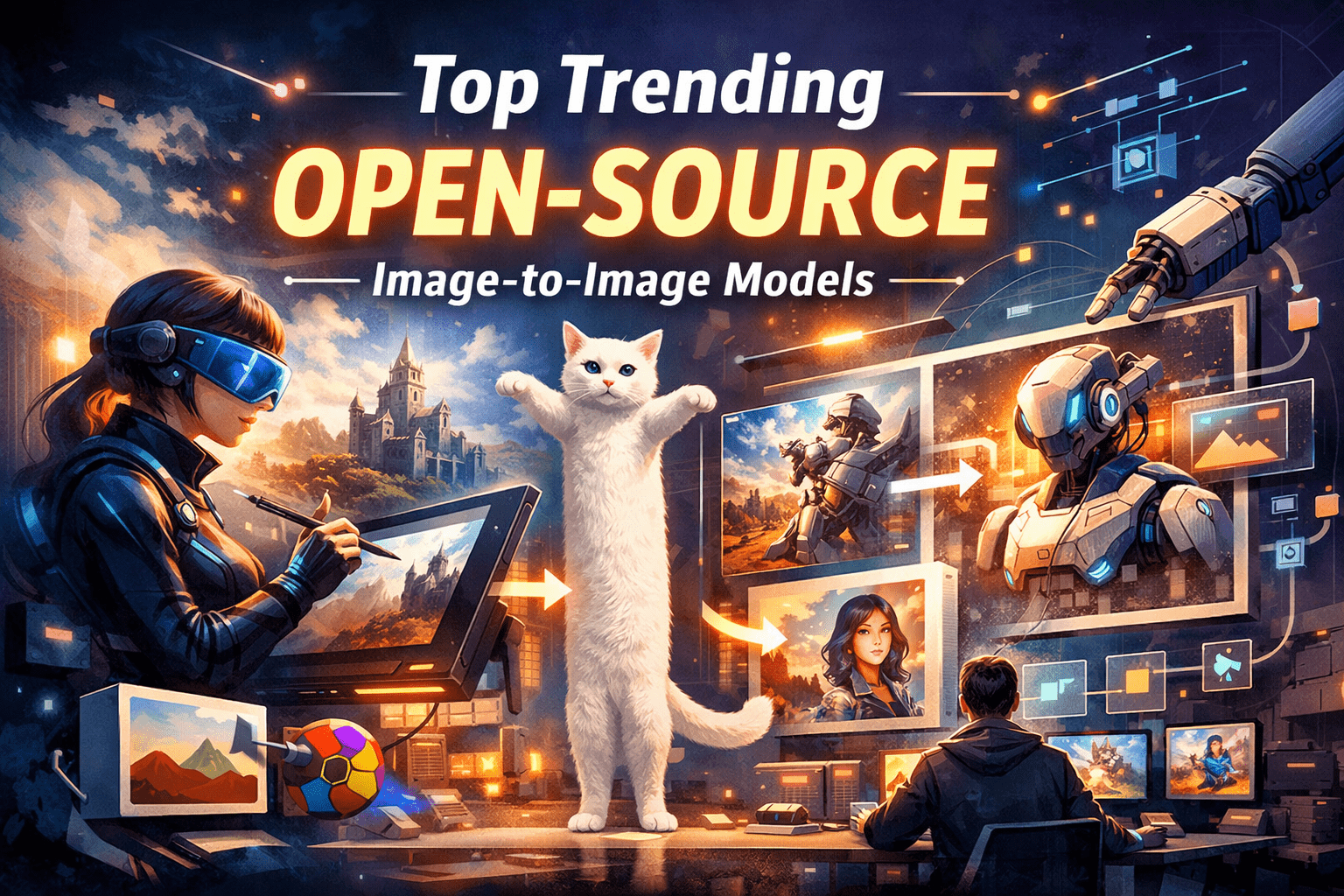
In this blog, we will look at some of the most talked-about open-source image-to-image models right now, including names like FLUX Dev, Qwen-based vision models, and newer experimental projects such as LongCat. Each of these models brings something different to the table.
1. FLUX Dev
FLUX Dev is currently one of the most exciting open-source image models available. It is developed with a strong focus on visual fidelity and prompt accuracy, especially for image-to-image workflows.
What makes FLUX Dev stand out is how well it preserves structure. When you pass an input image, it respects composition, pose, and layout while still allowing meaningful transformation. This makes it ideal for tasks like style transfer, character redesigns, concept art refinement, and product mockups.
Key strengths:
Very high image quality with sharp details
Strong control over structure in image-to-image tasks
Open weights, friendly for fine-tuning
Performs well with both realistic and stylized images
FLUX Dev is quickly becoming a favorite among serious creators who want quality without giving up control.
2. Qwen-Based Vision and Image Models
The Qwen ecosystem is better known for language models, but its vision and multimodal extensions are gaining attention fast. While not purely image-generation models at first, newer Qwen-based projects now support image understanding and image-to-image generation pipelines.
These models are especially interesting because they combine visual reasoning with transformation. That means they do not just change an image, they understand it. This is useful for tasks like guided edits, object-aware transformations, and design iterations based on instructions.
Key strengths:
Strong image understanding combined with generation
Works well for instruction-based image editing
Open-source and actively developed
Good foundation for building custom image tools
Qwen-based image models are a solid choice if you want smarter image-to-image workflows rather than just visual effects.
3. LongCat
LongCat is a newer and more experimental open-source image model that has started to trend in research and indie creator communities. It focuses on long-range consistency, meaning it tries to maintain coherence across complex images with many elements.
This model is still evolving, but early results show promise in areas where traditional diffusion models struggle, such as crowded scenes, repeated patterns, or large compositions that need consistency from one side of the image to the other.
Key strengths:
Better handling of complex, large-scale compositions
Promising consistency in image-to-image transformations
Fully open-source and research-friendly
Interesting base for experimentation and future improvements
LongCat may not yet be as polished as FLUX Dev, but it is worth watching closely.
4. Stable Diffusion Image-to-Image Variants
Even though Stable Diffusion is not new, it continues to evolve through community-driven variants and fine-tuned checkpoints. Many of the best image-to-image results today still come from customized Stable Diffusion setups.
These variants shine when paired with ControlNet, LoRA, and other add-ons. You can guide pose, depth, edges, and even lighting, all while transforming the original image.
Key strengths:
Massive ecosystem and community support
Excellent control with add-ons like ControlNet
Easy to customize and fine-tune
Reliable for production workflows
Stable Diffusion remains the note you always come back to, especially for image-to-image tasks.
5. Kandinsky (Open Versions)
Kandinsky’s open releases continue to be relevant, especially for artistic and abstract transformations. These models are known for their color handling and creative interpretation of input images.
They may not always match FLUX Dev in realism, but they excel in expressive styles, illustrations, and experimental art.
Key strengths:
Strong artistic and creative output
Good color balance and composition
Open-source and well documented
Useful for stylized image-to-image workflows
Final Thoughts
Open-source image-to-image models are no longer just alternatives. In many cases, they are leading the field. Models like FLUX Dev are setting new standards for quality, while projects like Qwen-based vision models and LongCat are pushing the boundaries of what image-to-image systems can understand and maintain.
If your priority is raw image quality, start with FLUX Dev. If you care about intelligent edits and instruction-based workflows, explore Qwen-based models. And if you enjoy experimenting at the edge, LongCat is worth your time.
The best part is that all of these models are open. You are free to test, modify, and build on top of them, which is exactly why this space is moving so fast.