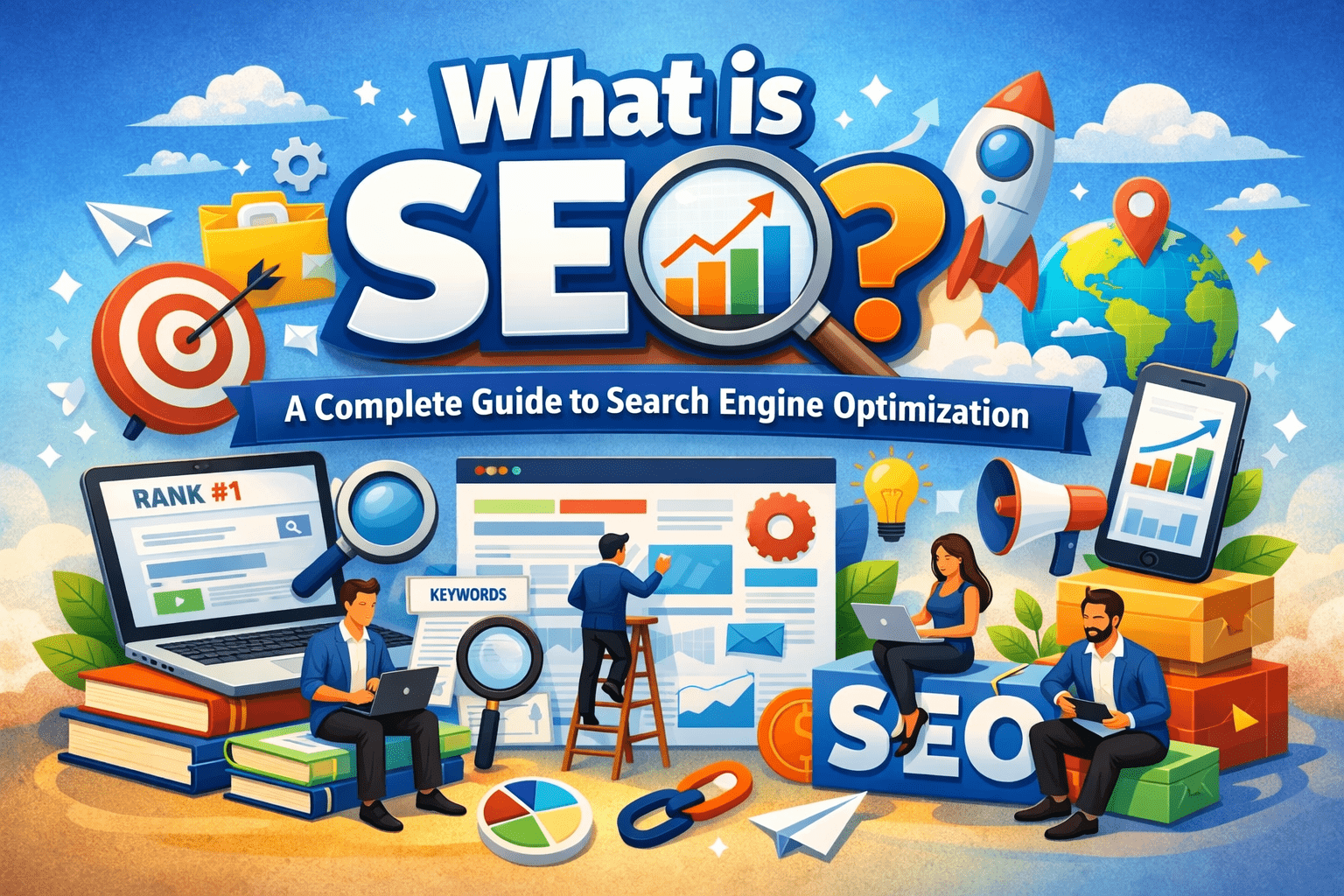
What Is SEO?
Have you ever searched for something on Google and clicked one of the first few results?
Maybe you searched for:
- Best smartphones under $500
- How to lose weight naturally
- Learn Python online
- Best restaurants near me
Within seconds, Google showed thousands of websites. However, you probably clicked only one or two results from the first page.
Have you ever wondered why those websites appeared at the top?
The answer is SEO, which stands for Search Engine Optimization.
SEO helps websites appear in search results when people look for information, products, or services online. As a result, websites receive more visitors without paying for advertisements.
Today, SEO is one of the most valuable digital marketing skills. Whether you own a business, run a blog, sell products online, or work as a freelancer, learning SEO can help you grow your online presence.
In this beginner-friendly guide, you’ll learn what SEO is, why it matters, and how search engines decide which websites appear first.
What Does SEO Mean?
SEO stands for Search Engine Optimization.
Simply put, it is the process of improving a website so that search engines like Google and Bing can understand its content and show it to the right audience.
The main goal of SEO is simple:
Help your website rank higher in search engine results.
When your pages appear on the first page of Google, more people can find your website. Consequently, you can attract more visitors, build trust, and grow your business.
For example, imagine you own a travel blog. If someone searches for “best places to visit in Italy,” good SEO can help your article appear among the top search results.
Therefore, the better your content matches what people are searching for, the greater your chances of receiving organic traffic.
Breaking Down the Term SEO
The phrase Search Engine Optimization has three parts. Understanding each one makes SEO much easier to understand.
Search
Every day, billions of people search online for answers.
They search for:
- Products
- Services
- News
- Tutorials
- Reviews
- Local businesses
- Recipes
- Educational content
People use search engines because they want quick and reliable answers. Therefore, search engines work hard to show the most useful results.
Engine
A search engine is a software system that finds, stores, and organizes web pages.
Some of the most popular search engines include:
- Bing
- Yahoo
- DuckDuckGo
- Baidu
- Yandex
Among these, Google is the most widely used. In fact, it processes billions of searches every day.
Optimization
Optimization means improving something to achieve better results.
In SEO, optimization means making your website easier for both users and search engines to understand.
For example, optimization includes:
- Writing useful content
- Improving page speed
- Using clear headings
- Optimizing images
- Making your website mobile-friendly
- Creating an excellent user experience
In other words, SEO is about helping people first and search engines second.
Why Is SEO Important?
Creating a website is only the first step.
If nobody can find it, your content won’t reach the people who need it.
SEO solves this problem by helping your website appear in relevant search results.
Let’s look at some of the biggest benefits.
1. SEO Increases Website Traffic
One of the biggest advantages of SEO is that it brings organic traffic.
Organic traffic means visitors who find your website naturally through search engines instead of paid advertisements.
For example, if your article ranks on the first page of Google, it can continue attracting readers every day.
As a result, you receive steady traffic without paying for every click.
2. SEO Builds Trust
People usually trust websites that appear near the top of Google.
Although rankings are not the only sign of quality, users often believe top-ranking websites are more reliable.
Therefore, strong SEO can improve both your visibility and your credibility.
3. SEO Reaches the Right Audience
Not every website visitor is the same.
Fortunately, SEO helps you attract people who are already interested in your content.
For example:
Someone searching for “How to bake chocolate cake” wants a recipe.
On the other hand, someone searching for “Buy chocolate cake online” is ready to make a purchase.
Because SEO targets specific search queries, it connects your website with the right audience.
4. SEO Delivers Long-Term Results
Paid advertisements stop working as soon as your budget runs out.
SEO works differently.
A well-written article can continue bringing visitors for months or even years.
Although SEO takes time, the long-term benefits often make it one of the best marketing investments.
5. SEO Improves User Experience
Modern SEO is not just about keywords.
Instead, it focuses on creating a better experience for visitors.
For example, Google prefers websites that are:
- Fast
- Secure
- Easy to navigate
- Mobile-friendly
- Helpful
When users enjoy your website, they stay longer and are more likely to return.
Consequently, both visitors and search engines benefit.
Who Should Learn SEO?
SEO is useful for almost everyone who has an online presence.
Let’s look at some examples.
Bloggers
Bloggers use SEO to increase readers and grow their audience.
Higher rankings often lead to more page views and more subscribers.
Business Owners
Businesses use SEO to reach potential customers.
Whether you own a local shop or a global company, SEO can help people discover your products and services.
Online Store Owners
E-commerce websites depend on search traffic to sell products.
By optimizing product pages, online stores can attract shoppers who are ready to buy.
Freelancers
Freelancers can use SEO to showcase their skills and attract new clients.
As their website gains visibility, more people discover their services.
Students and Beginners
Learning SEO is also a valuable career skill.
Many companies hire SEO professionals to improve their online visibility.
Therefore, SEO can open new career opportunities in digital marketing.
How Do Search Engines Work?
To understand SEO, you should first understand how search engines work.
Although Google’s systems are highly advanced, the basic process can be explained in four simple steps.
Step 1: Crawling
The first step is called crawling.
Search engines use automated programs known as crawlers, bots, or spiders.
These bots travel across the internet by following links from one webpage to another.
Whenever you publish a new page, Google may eventually discover it through crawling.
However, if search engines cannot access your page, it may never appear in search results.
Step 2: Rendering
After discovering a webpage, Google tries to understand how it looks.
This process is called rendering.
During rendering, Google analyzes:
- HTML
- CSS
- JavaScript
- Images
- Interactive elements
As a result, Google gains a better understanding of the complete webpage.
Step 3: Indexing
Once Google understands your page, it decides whether to store it in its database.
This database is called the Google Index.
Only indexed pages can appear in Google Search.
Therefore, indexing is essential for SEO success.
Step 4: Ranking
Finally, Google decides where your page should appear in search results.
It compares your content with millions of other pages.
Google considers many factors, including:
- Content quality
- Relevance
- User experience
- Website speed
- Mobile friendliness
- Website authority
- Freshness of information
After evaluating these signals, Google displays the pages it believes will best answer the user’s question.
How Does Google Choose the Best Results?
Google does much more than count keywords.
Instead, it tries to understand the overall quality and usefulness of a webpage.
For example, Google’s systems ask questions like:
- Does this page answer the user’s question?
- Is the information accurate?
- Is the content original?
- Is the page easy to read?
- Does the website show expertise?
- Is the website secure?
If the answer is yes, the page has a better chance of ranking well.
In short, Google wants to provide the best possible experience for its users.
SEO Is About Helping People
Years ago, some websites ranked by repeating keywords again and again.
Today, that approach no longer works.
Instead, Google rewards websites that create helpful, trustworthy, and easy-to-read content.
Therefore, your goal should always be to solve your readers’ problems.
If your content answers their questions clearly, visitors are more likely to trust your website and return in the future.
Over time, this approach also improves your search rankings.
Key Takeaways
Before moving to the next part, remember these important points:
- SEO stands for Search Engine Optimization.
- It helps websites appear in search engine results.
- Better rankings usually lead to more organic traffic.
- SEO improves both search visibility and user experience.
- Search engines crawl, render, index, and rank webpages.
- Helpful content is the foundation of successful SEO.
- SEO is a long-term strategy that requires patience and consistency.
Many beginners think SEO is only about adding keywords to an article. However, SEO is much more than that. It includes improving your content, making your website faster, building trust, and creating a better experience for visitors.
Each type of SEO plays a unique role. Together, they help your website rank higher and attract more organic traffic.
Let’s understand each type in simple language.
The Three Main Types of SEO
SEO is mainly divided into three categories:
- On-Page SEO
- Off-Page SEO
- Technical SEO
Besides these, there are also specialized types such as:
- Local SEO
- E-commerce SEO
- Enterprise SEO
- International SEO
- News SEO
Each one focuses on a different part of website optimization.
What Is On-Page SEO?
On-Page SEO includes everything you do on your own website to improve search rankings.
It helps search engines understand your content while making your pages easier for visitors to read.
In simple words, On-Page SEO is about creating useful content and organizing it properly.
When your pages are clear, informative, and easy to navigate, both users and search engines benefit.
Why Is On-Page SEO Important?
Good content alone is not enough.
You also need to present your content in a way that is easy to understand.
For example, a well-structured article with headings, images, and internal links is much easier to read than one long block of text.
As a result, visitors stay longer on your website, and search engines get a better understanding of your page.
Important Elements of On-Page SEO
Let’s look at the most important parts of On-Page SEO.
High-Quality Content
Content is the heart of SEO.
Without useful content, your website will struggle to rank well.
Good content should:
- Answer users’ questions
- Be accurate and informative
- Use simple language
- Include examples when needed
- Be updated regularly
Most importantly, write for people instead of search engines.
If your article solves a problem, visitors are more likely to trust your website.
Keyword Optimization
Keywords tell search engines what your page is about.
For example, if your article explains SEO basics, your main keyword might be:
What Is SEO
Use your keyword naturally in:
- Title
- Introduction
- Headings
- Conclusion
However, avoid repeating it too often.
Instead, use related words and natural language throughout your article.
SEO-Friendly Titles
Your page title is one of the first things people notice in Google Search.
A good title should:
- Clearly describe the topic
- Include your focus keyword
- Encourage users to click
For example:
✅ What Is SEO? A Complete Beginner’s Guide
This title tells readers exactly what they can expect.
Meta Description
A meta description is the short text shown below your page title in search results.
Although it does not directly improve rankings, it can increase the number of people who click your page.
A good meta description should:
- Explain the article
- Include the main keyword naturally
- Be clear and engaging
Think of it as a short advertisement for your webpage.
Heading Structure
Headings make your content easier to read.
Instead of writing one long article, divide it into smaller sections.
Use headings like:
- H1 for the page title
- H2 for major topics
- H3 for smaller sections
This structure helps readers scan your article quickly.
At the same time, search engines understand your content more easily.
Internal Links
Internal links connect one page of your website to another.
For example, if you’re writing about SEO, you can link to articles about:
- Keyword Research
- Technical SEO
- Google Search Console
Internal links help visitors explore your website.
In addition, they help search engines discover more of your content.
Image Optimization
Images make articles more attractive.
However, they should also be optimized.
Follow these simple tips:
- Compress large images
- Use descriptive file names
- Add alt text
- Choose high-quality images
For example:
Instead of:
IMG001.jpg
Use:
what-is-seo-guide.jpg
This small change helps search engines understand your images better.
SEO-Friendly URLs
A simple URL is easier for everyone.
Good example:
yourwebsite.com/what-is-seoPoor example:
yourwebsite.com/post?id=123456Short and descriptive URLs improve both user experience and SEO.
What Is Off-Page SEO?
Unlike On-Page SEO, Off-Page SEO focuses on activities that happen outside your website.
Its main goal is to build your website’s reputation.
Search engines trust websites that other trusted websites recommend.
This is why backlinks are so important.
What Are Backlinks?
A backlink is simply a link from another website to yours.
Imagine someone recommends your website in their article.
That recommendation acts like a vote of confidence.
As your website earns more high-quality backlinks, search engines begin to trust your content more.
However, quality always matters more than quantity.
One backlink from a respected website is far more valuable than dozens of links from low-quality websites.
How to Get Backlinks Naturally
The safest way to earn backlinks is by creating valuable content.
People naturally link to articles that solve problems.
Here are some effective methods:
- Publish detailed guides
- Create useful tools
- Share original research
- Write guest posts
- Design helpful infographics
- Create free templates
Instead of buying backlinks, focus on creating content worth sharing.
Brand Mentions
Sometimes people mention your business without linking to your website.
These are called brand mentions.
Although they are different from backlinks, they still help build your online reputation.
As more people recognize your brand, your authority can grow over time.
Does Social Media Help SEO?
Many beginners ask this question.
The answer is:
Not directly.
Google does not use social media likes or shares as direct ranking factors.
However, social media can still support your SEO efforts.
For example, sharing your content on social platforms can:
- Increase website traffic
- Reach a larger audience
- Generate more backlinks
- Improve brand awareness
Therefore, social media and SEO work well together.
What Is Technical SEO?
Technical SEO focuses on improving your website’s technical performance.
Even great content may struggle to rank if search engines cannot properly crawl or understand your website.
Think of Technical SEO as building a strong foundation for your website.
Important Parts of Technical SEO
Let’s look at some key elements.
Website Speed
Visitors expect websites to load quickly.
If a page takes too long to load, many users leave before reading it.
Therefore, improving website speed should always be a priority.
You can improve speed by:
- Compressing images
- Reducing unnecessary code
- Using fast web hosting
- Enabling browser caching
A faster website creates a better experience for everyone.
Mobile-Friendly Design
Today, most people browse the internet on smartphones.
Because of this, Google mainly evaluates the mobile version of your website.
Your website should:
- Adjust to different screen sizes
- Display readable text
- Have clickable buttons
- Load quickly on mobile devices
Responsive design is now essential.
HTTPS Security
Visitors want their information to remain safe.
HTTPS encrypts data between your website and its users.
Secure websites also appear more trustworthy.
If your website still uses HTTP, consider switching to HTTPS.
XML Sitemap
An XML sitemap helps search engines discover your important pages.
Think of it as a roadmap for your website.
Although Google can often find pages through links, a sitemap makes the process easier.
Robots.txt File
The robots.txt file tells search engines which pages they should or shouldn’t crawl.
Using it correctly helps search engines focus on your important content.
Structured Data
Structured data, also called Schema Markup, provides additional information about your content.
For example, it can identify:
- Articles
- Products
- Reviews
- FAQs
- Recipes
- Events
As a result, search engines understand your content more accurately.
What Is Local SEO?
Local SEO helps businesses appear in location-based searches.
For example:
- Coffee shop near me
- Dentist in Mumbai
- Best hotel in Delhi
If you own a local business, Local SEO can help nearby customers find you.
Important Local SEO activities include:
- Creating a Google Business Profile
- Collecting customer reviews
- Using local keywords
- Keeping business information accurate
What Is E-commerce SEO?
E-commerce SEO focuses on online stores.
Instead of ranking blog articles, it helps product pages appear in search results.
It includes optimizing:
- Product titles
- Product descriptions
- Product images
- Category pages
- Customer reviews
Good E-commerce SEO helps shoppers find products more easily.
Enterprise SEO
Large companies often manage websites with thousands of pages.
This is where Enterprise SEO becomes important.
It focuses on:
- Large-scale optimization
- Team collaboration
- Automation
- Technical improvements
- Content management
Enterprise SEO is commonly used by major brands and large organizations.
International SEO
Some businesses serve customers in multiple countries.
International SEO helps search engines display the correct language and regional version of a website.
For example, a global company may have websites in:
- English
- French
- Spanish
- German
- Japanese
International SEO ensures users receive content that matches their language and location.
News SEO
News websites compete to publish breaking stories quickly.
News SEO helps articles appear in:
- Google News
- Top Stories
- Google Discover
Success depends on:
- Fast publishing
- Accurate reporting
- Fresh content
- Proper structured data
Because news changes rapidly, speed is especially important.
Beginner’s On-Page SEO Checklist
Before publishing any article, review this checklist.
✔ Write original content.
✔ Use your focus keyword naturally.
✔ Create an engaging SEO title.
✔ Write a clear meta description.
✔ Organize content with headings.
✔ Add internal links.
✔ Optimize images.
✔ Keep URLs short.
✔ Make your website mobile-friendly.
✔ Check spelling and grammar.
✔ Improve readability with short paragraphs.
✔ Answer the user’s search intent.
Following these simple steps will help create content that both readers and search engines appreciate.
Key Takeaways
Before moving to Part 3, remember these important points:
- On-Page SEO improves your website’s content.
- Off-Page SEO builds trust and authority.
- Technical SEO improves website performance.
- Local SEO helps businesses reach nearby customers.
- E-commerce SEO focuses on online stores.
- Enterprise SEO supports large websites.
- International SEO targets multiple countries.
- News SEO helps publishers rank for current events.
Together, these SEO types create a strong foundation for better search rankings.
A successful SEO strategy is not about guessing what people want. Instead, it starts with understanding your audience, choosing the right keywords, and creating content that answers real questions.
Let’s explore each step in simple language.
What Is Keyword Research?
Keyword research is the process of finding the words and phrases that people type into search engines.
These search terms help you understand what your audience is looking for.
For example, if you have a travel blog, people may search for:
- Best places to visit in Japan
- Cheap flights to Europe
- Travel tips for beginners
- Best beaches in Thailand
These search phrases are called keywords.
When you create content around these keywords, your website has a better chance of appearing in search results.
Therefore, keyword research is one of the first steps in every SEO strategy.
Why Is Keyword Research Important?
Many beginners write articles based on topics they personally like.
However, successful SEO focuses on what users are actually searching for.
Keyword research helps you:
- Find popular topics
- Understand your audience
- Discover new content ideas
- Increase organic traffic
- Reach the right visitors
As a result, you create content that people already want to read.
Types of Keywords
Not all keywords are the same.
Each type has a different purpose.
Let’s understand them one by one.
Short-Tail Keywords
Short-tail keywords contain one or two words.
Examples include:
- SEO
- Laptop
- Shoes
- Photography
These keywords receive many searches.
However, they are also highly competitive.
Because of this, beginners often find them difficult to rank for.
Long-Tail Keywords
Long-tail keywords contain three or more words.
For example:
- What is SEO for beginners
- Best budget laptop for students
- Healthy breakfast ideas for weight loss
Although these keywords have lower search volume, they usually attract more targeted visitors.
Therefore, beginners should focus on long-tail keywords whenever possible.
Informational Keywords
People use informational keywords when they want to learn something.
Examples include:
- What is SEO?
- How to bake a cake
- Learn JavaScript
- How to start a blog
These keywords work well for tutorials, guides, and educational articles.
Transactional Keywords
Transactional keywords show buying intent.
Examples include:
- Buy gaming laptop
- Best web hosting plans
- Order pizza online
Visitors searching these keywords are usually ready to make a purchase.
Therefore, businesses often target these keywords on product and service pages.
Understanding Search Intent
Choosing the right keyword is only the first step.
You must also understand search intent.
Search intent is the reason behind a user’s search.
Ask yourself:
Why is someone searching for this keyword?
When your content matches search intent, visitors are more likely to stay on your website.
As a result, Google sees your content as helpful.
The Four Types of Search Intent
There are four main types of search intent.
Informational Intent
Users want to learn something.
Examples include:
- What is SEO?
- How to cook pasta
- Learn graphic design
These searches require detailed and helpful articles.
Navigational Intent
Users already know which website they want.
Examples include:
- Gmail
- YouTube Studio
In this case, they simply want to reach a specific website.
Commercial Intent
Users are comparing products before making a decision.
For example:
- Best DSLR camera
- Grammarly review
- iPhone vs Samsung
Comparison articles perform well for these searches.
Transactional Intent
Users are ready to buy.
Examples include:
- Buy iPhone online
- Purchase web hosting
- Order birthday cake
These keywords are ideal for product pages and online stores.
How to Create SEO-Friendly Content
Content is one of the most important parts of SEO.
However, simply writing a long article is not enough.
Your content should also be:
- Helpful
- Original
- Easy to read
- Well organized
- Updated regularly
Most importantly, it should answer the reader’s question.
Write for People First
Always write for your readers.
Although keywords are important, your content should sound natural.
Instead of repeating the same keyword many times, explain the topic clearly.
For example:
- Use simple language.
- Add examples.
- Break complex ideas into smaller sections.
- Answer common questions.
When readers enjoy your content, search engines notice that too.
Organize Your Content
Good organization improves readability.
Instead of writing one long block of text, divide your article into sections.
For example:
- Introduction
- Main Topic
- Tips
- Examples
- FAQs
- Conclusion
This structure makes your article easier to understand.
Additionally, search engines can better identify the main topics.
Use Internal Links
Internal links connect one page of your website to another.
For example, an SEO article could link to pages about:
- Keyword Research
- Technical SEO
- Google Analytics
- Google Search Console
Internal links help visitors discover more content.
Moreover, they help search engines crawl your website more efficiently.
Add External Links
External links point to trusted websites outside your own.
For example, you may link to:
- Official documentation
- Government websites
- Educational resources
- Industry research
These links provide additional information for readers.
However, always choose reliable sources.
What Is Image SEO?
Images make articles more attractive.
At the same time, they can also improve SEO when optimized correctly.
Image SEO helps search engines understand your visuals while improving page speed.
Best Practices for Image SEO
Here are some simple tips.
Use Descriptive File Names
Instead of:
image001.jpg
Use:
seo-keyword-research.jpg
This tells search engines what the image shows.
Add Alt Text
Alt text describes an image.
It helps:
- Search engines understand images.
- Screen readers assist visually impaired users.
For example:
“Illustration explaining keyword research for SEO.”
Clear alt text improves accessibility and SEO.
Compress Images
Large images slow down websites.
Therefore, compress images before uploading them.
Smaller image files improve loading speed without reducing quality too much.
What Is Schema Markup?
Schema Markup is a special type of code that helps search engines understand your content.
For example, it can identify:
- Articles
- Products
- Reviews
- FAQs
- Events
- Recipes
As a result, your pages may become eligible for rich search results, which can make them more noticeable.
Why Is Mobile SEO Important?
Today, most people browse websites using smartphones.
Because of this, Google mainly evaluates the mobile version of your website.
Your website should:
- Load quickly
- Display correctly on all devices
- Use readable fonts
- Have clickable buttons
- Adjust automatically to different screen sizes
A responsive website creates a better experience for visitors.
What Are Core Web Vitals?
Core Web Vitals measure how users experience your website.
Google uses these signals to evaluate page performance.
The three main Core Web Vitals are:
Largest Contentful Paint (LCP)
Measures how quickly the main content loads.
Faster loading pages create a better user experience.
Interaction to Next Paint (INP)
Measures how quickly a page responds when users click or tap.
Responsive websites feel smoother and easier to use.
Cumulative Layout Shift (CLS)
Measures unexpected page movement while loading.
Stable pages are easier to read because buttons and text stay in place.
AI Is Changing SEO
Artificial Intelligence is transforming search engines.
Today, Google understands content much better than before.
Instead of focusing only on keywords, it also looks at:
- User intent
- Content quality
- Expertise
- Trustworthiness
- User experience
Therefore, creating genuinely helpful content has become more important than ever.
Google’s Helpful Content System
Google encourages website owners to create content for people first.
Before publishing an article, ask yourself:
- Does this answer the reader’s question?
- Is the information accurate?
- Is the content original?
- Is it easy to understand?
- Would I recommend this article to someone else?
If the answer is yes, you’re creating helpful content.
Over time, this approach can improve both rankings and user trust.
Simple SEO Tips for Beginners
If you’re just starting, remember these practical tips:
- Focus on one main keyword.
- Write naturally.
- Use short paragraphs.
- Add descriptive headings.
- Include relevant images.
- Link to related articles.
- Update old content regularly.
- Improve page speed.
- Make your website mobile-friendly.
- Always write for your audience.
Small improvements made consistently often produce the best long-term results.
Key Takeaways
Before moving to the final part, remember these important points:
- Keyword research helps you understand your audience.
- Long-tail keywords are easier for beginners to target.
- Search intent is just as important as keywords.
- Helpful content performs better than keyword stuffing.
- Internal and external links improve your website.
- Optimized images support both SEO and accessibility.
- Mobile-friendly websites rank better.
- AI is making content quality more important than ever.
What Is Link Building?
Link building is the process of getting other websites to link to your website.
These links are called backlinks.
Think of backlinks as recommendations. When a trusted website links to one of your pages, search engines see it as a sign that your content is useful and trustworthy.
However, not every backlink has the same value.
One backlink from a well-known website is usually much more valuable than many links from low-quality websites.
Therefore, focus on earning high-quality backlinks instead of collecting a large number of weak ones.
Why Are Backlinks Important?
Backlinks are one of the signals search engines use to understand the popularity and authority of a website.
When trusted websites link to your content, it becomes easier for search engines to trust your pages as well.
As a result, good backlinks can help you:
- Improve search rankings
- Increase organic traffic
- Build website authority
- Reach new audiences
- Strengthen your online reputation
Although backlinks are important, they should always be earned naturally.
Safe Ways to Build Backlinks
There are many ethical ways to earn backlinks.
Let’s look at some of the most effective methods.
Publish Helpful Content
People naturally link to articles that provide useful information.
For example, detailed guides, tutorials, and step-by-step articles often attract backlinks because they solve real problems.
The more valuable your content is, the more likely people are to recommend it.
Write Guest Posts
Guest blogging allows you to publish articles on other websites in your industry.
In return, you may receive a backlink to your own website.
However, choose reputable websites that are relevant to your niche.
Quality always matters more than quantity.
Create Original Research
Original research attracts attention because it provides unique information.
For example, you can publish:
- Surveys
- Industry reports
- Case studies
- Statistics
- Data analysis
Journalists and bloggers often link to original research when writing their own articles.
Build Free Tools
People enjoy sharing useful online tools.
Simple tools such as calculators, generators, or templates can naturally earn backlinks over time.
Examples include:
- SEO Checklist
- Password Generator
- Image Converter
- BMI Calculator
- QR Code Generator
Useful tools provide value, which encourages people to share them.
Common SEO Mistakes to Avoid
Even experienced website owners sometimes make SEO mistakes.
Fortunately, most of these mistakes are easy to avoid.
Keyword Stuffing
Years ago, repeating keywords helped websites rank.
Today, it does the opposite.
Instead of forcing keywords into every sentence, write naturally.
For example:
❌ SEO SEO SEO SEO Guide
✅ Learn SEO by creating helpful content that answers users’ questions.
Natural writing creates a better experience for readers.
Ignoring Search Intent
Many websites target the right keyword but answer the wrong question.
Always think about what the user expects.
For example:
Someone searching “What is SEO?”
wants an explanation.
Someone searching “Buy SEO Course”
wants a product or service.
Matching search intent increases the chances of ranking well.
Publishing Low-Quality Content
Short articles with little useful information rarely perform well.
Instead, create content that:
- Solves problems
- Explains topics clearly
- Includes examples
- Answers common questions
Helpful content performs much better over time.
Slow Website Speed
Nobody enjoys waiting for a slow website.
If your pages load slowly, visitors may leave before reading your content.
Therefore, improve loading speed by:
- Compressing images
- Removing unnecessary plugins
- Choosing reliable hosting
- Reducing large files
A faster website creates a better user experience.
Forgetting Mobile Users
Most people browse the internet on smartphones.
Because of this, every website should work well on smaller screens.
Make sure your website:
- Loads quickly
- Uses readable text
- Has responsive layouts
- Displays images correctly
A mobile-friendly website benefits both visitors and search engines.
Not Updating Old Articles
SEO is not a one-time task.
Over time, information changes.
Therefore, review your older articles regularly.
You can:
- Update statistics
- Add new examples
- Improve readability
- Replace outdated screenshots
- Add fresh information
Updated content often performs better in search results.
Best SEO Tools for Beginners
The right tools make SEO easier.
Here are some popular options.
Google Search Console
Google Search Console is one of the most useful free SEO tools.
It helps you:
- Monitor search performance
- Check indexing status
- Find technical issues
- Submit XML sitemaps
- View search queries
Every website owner should use it.
Google Analytics
Google Analytics helps you understand how visitors use your website.
For example, you can see:
- Number of visitors
- Traffic sources
- Popular pages
- User behavior
- Conversion data
This information helps you improve your content strategy.
Keyword Research Tools
Keyword research tools help you discover what people are searching for.
They provide useful information such as:
- Search volume
- Keyword difficulty
- Related keywords
- Search trends
As a result, choosing the right topics becomes much easier.
Website Audit Tools
Website audit tools scan your website for technical SEO problems.
They can identify issues such as:
- Broken links
- Missing meta descriptions
- Duplicate titles
- Slow pages
- Crawl errors
Fixing these problems improves your website’s overall health.
How to Learn SEO
SEO may seem difficult at first.
However, anyone can learn it with practice.
Follow these simple steps.
Learn the Basics
Start by understanding:
- How search engines work
- Keyword research
- On-Page SEO
- Technical SEO
- Content optimization
A strong foundation makes advanced topics much easier.
Build Your Own Website
Practice is the best teacher.
Create a simple website and experiment with:
- Writing articles
- Optimizing pages
- Improving page speed
- Adding internal links
- Monitoring rankings
The more you practice, the more confident you’ll become.
Measure Your Progress
SEO takes time.
Therefore, monitor your results regularly.
Track:
- Organic traffic
- Rankings
- Click-through rate
- User engagement
Small improvements add up over time.
Continue Learning
Google updates its search systems regularly.
Because of this, SEO is always evolving.
Reading trusted blogs, watching tutorials, and testing new ideas will help you stay up to date.
SEO as a Career
SEO has become one of the fastest-growing skills in digital marketing.
Businesses of all sizes need experts who can improve their online visibility.
Some common SEO careers include:
- SEO Specialist
- Technical SEO Expert
- SEO Consultant
- Content Strategist
- SEO Analyst
- Digital Marketing Manager
- Local SEO Specialist
As more businesses move online, the demand for SEO professionals continues to grow.
The Future of SEO
SEO continues to change every year.
Several important trends are shaping its future.
AI-Powered Search
Artificial Intelligence is helping search engines understand content more accurately.
Because of this, creating useful and trustworthy content is becoming even more important.
Voice Search
Many people now search using voice assistants.
Voice searches are usually longer and more conversational.
Writing naturally helps your content match these searches.
Better User Experience
Google increasingly rewards websites that offer a great user experience.
For example, your website should:
- Load quickly
- Work well on mobile devices
- Be easy to navigate
- Provide useful information
These improvements benefit both users and search engines.
Helpful Content
Google encourages creators to write for people first.
Instead of trying to trick search engines, focus on solving your readers’ problems.
Helpful content remains one of the strongest long-term SEO strategies.
Frequently Asked Questions
Learn the fundamentals of Search Engine Optimization (SEO), including how long it takes to see results, whether SEO is free, how beginners can get started, the differences between SEO and paid advertising, and how AI is influencing modern search engines.
How long does SEO take?
SEO is a long-term digital marketing strategy rather than a quick solution. While some websites begin seeing measurable improvements within a few months, others may require six months or longer depending on their industry, competition, website authority, and content quality.
Search engines need time to discover, crawl, index, and evaluate new content. Consistently publishing valuable content, improving technical SEO, earning quality backlinks, and optimizing user experience all contribute to stronger rankings over time.
Is SEO free?
Organic search traffic is considered "free" because you do not pay for each visitor who clicks on your website from search engine results. Unlike paid advertising, there is no cost per click for organic rankings.
However, successful SEO still requires an investment of time, expertise, and sometimes money for content creation, keyword research, website optimization, analytics tools, or professional SEO services.
For many businesses, SEO becomes one of the most cost-effective marketing strategies because strong rankings can continue generating traffic long after content is published.
Can beginners learn SEO?
Yes. Anyone can learn SEO by understanding the fundamentals and applying them consistently on their own website or blog. You do not need advanced programming skills to begin improving your search visibility.
New learners should focus on topics such as:
- Keyword research
- Writing helpful content
- On-page SEO optimization
- Technical SEO basics
- Internal linking
- Page speed and user experience
The most important factor is consistency. Regular learning, testing, and improving your website will gradually build SEO knowledge and experience.
Is SEO better than paid advertising?
Neither strategy is universally better—they serve different purposes. SEO focuses on building sustainable, long-term organic traffic, while paid advertising helps generate immediate visibility and faster results.
A balanced digital marketing strategy often combines both approaches:
- SEO: Long-term traffic, authority, and lower ongoing acquisition costs.
- Paid Ads: Instant visibility, targeted campaigns, and rapid lead generation.
Many successful businesses use paid advertising to generate short-term traffic while simultaneously investing in SEO to create lasting growth.
Does AI replace SEO?
No. Artificial intelligence is transforming how search engines understand, organize, and evaluate content, but it does not eliminate the need for SEO. Instead, SEO continues to evolve alongside advances in AI-powered search.
Modern search engines increasingly reward content that is accurate, useful, well-structured, and written for real users rather than solely for ranking algorithms.
To remain competitive, focus on:
- Creating helpful, original content.
- Answering user questions clearly.
- Improving website speed and usability.
- Building trust and topical authority.
- Keeping information accurate and up to date.
SEO Checklist Before Publishing
Before publishing any article, review this checklist:
- ✅ Choose one focus keyword.
- ✅ Understand the user’s search intent.
- ✅ Write original and helpful content.
- ✅ Create a strong SEO title.
- ✅ Write a clear meta description.
- ✅ Use proper headings.
- ✅ Add internal links.
- ✅ Include trusted external references when needed.
- ✅ Optimize images.
- ✅ Keep URLs short.
- ✅ Improve page speed.
- ✅ Test your website on mobile devices.
- ✅ Check grammar and readability.
- ✅ Update content regularly.
Following this checklist will help you create content that is useful for readers and easier for search engines to understand.
Final Thoughts
SEO is much more than adding keywords to a webpage. It is a long-term strategy that helps people discover your content through search engines.
Throughout this guide, you’ve learned how SEO works, why it matters, and how to improve your website step by step. More importantly, you’ve seen that successful SEO is built on helpful content, a great user experience, and continuous improvement.
Remember, SEO is not about finding shortcuts. Instead, it is about creating valuable content that answers real questions and solves real problems. As you continue learning and applying these techniques, your website can gradually gain more visibility, attract the right audience, and build lasting trust.
Keep practicing, keep updating your content, and stay informed about new SEO trends. With patience and consistency, SEO can become one of the most powerful ways to grow your website and succeed online.